
The Silent Struggle
07/11/2025 | Sri likhitha Guttikonda
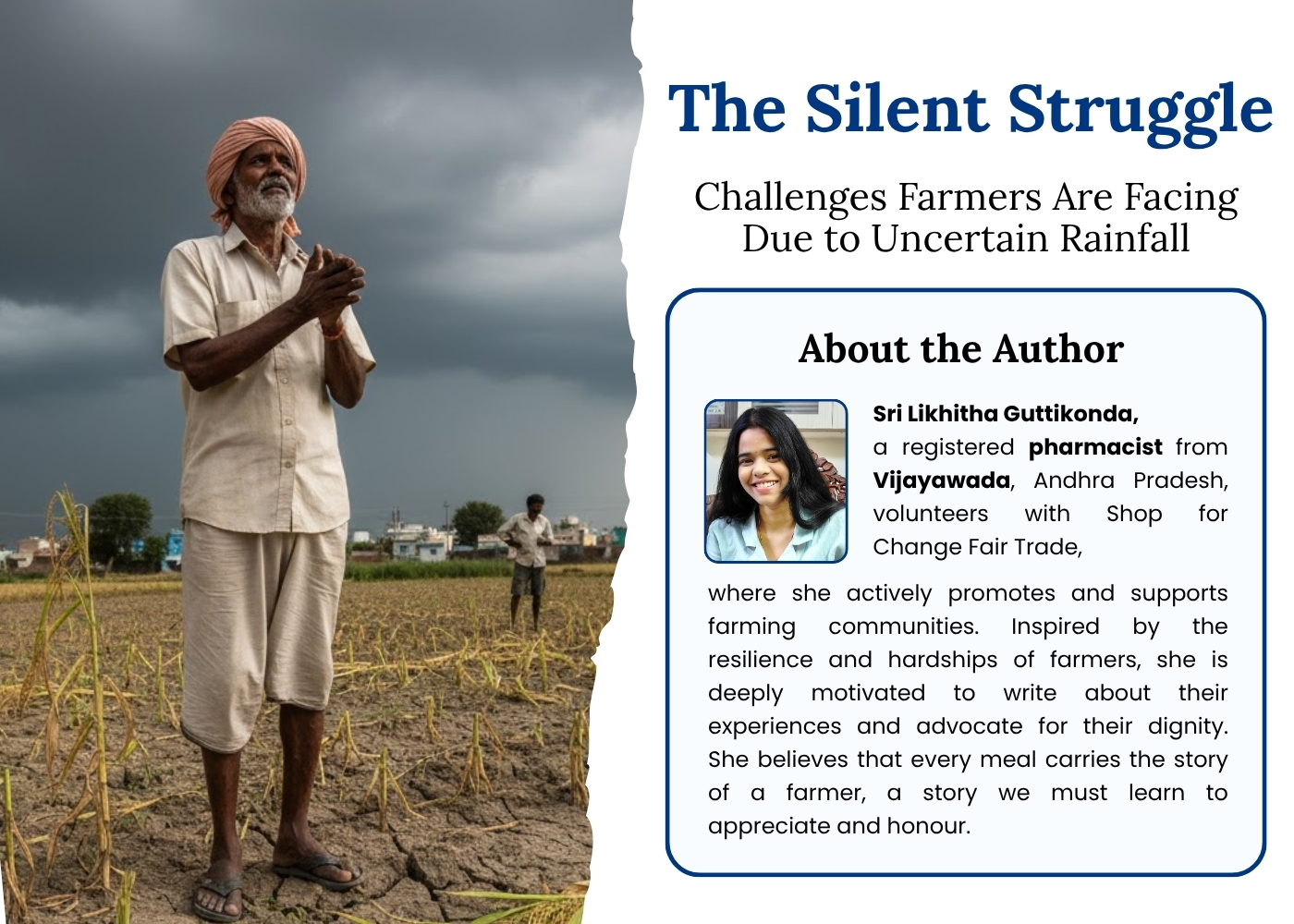
The Silent Struggle: Challenges Farmers Are Facing Due to Uncertain Rainfall
In many parts of India, the first drop of monsoon rain is not just water falling from the sky—it is celebration, relief, and life itself. For generations, farmers have looked to the clouds the way sailors look to the horizon. The clouds guided them. The clouds promised hope.
But today, the clouds have become unpredictable. The rain comes late, or not at all. Sometimes it pours too much, too fast—destroying what it was once meant to nourish. And farmers, whose lives depend on the rhythm of the seasons, are left standing in fields of uncertainty.
“We Used to Know the Seasons. Now, the Seasons Don’t Know Us.”
In Vidarbha, Maharashtra, cotton farmer Ramesh Pawar walks across his field, his steps slow, his eyes tired. Last June, he planted cotton seeds exactly as his father had taught him. But the rain did not come. The soil cracked with heat. When the rain finally arrived a month later, it was angry—heavy floods washed away the fragile sprouts.
“We do everything right,” he says softly. “But now nature doesn’t follow rules.”
Ramesh had to borrow money to replant. Now, every cloud in the sky brings not just hope—but fear.
The Wells That Keep Getting Deeper
In Anantapur, Andhra Pradesh, the land is dry and silent. Lakshmi, a farmer in her early forties, points to three borewell pits behind her house. Each one cost her family more than a lakh rupee. Each one is dry.
“When I was a girl, we had a pond here,” she recalls. “We filled our pots, our cattle drank, the fields grew green. Today… even the ground feels thirsty.”
She laughs a little, but it is the kind of laugh that comes before tears. The journey to water is getting longer. The earth is giving less.
When Pests Arrive Before the Rain
In Punjab, where rice paddies once stood tall and sure, farmers now whisper about pests. The brown planthopper—the tiny insect that destroys entire crops—thrives when rains fluctuate.
“Rain stopped suddenly,” says Harpreet Singh, a farmer from Amritsar. “Humidity rose, and within days, the pests spread. We watched the fields fall sick.”
He waited for the sound of rain. Instead, he heard silence.
The Quiet Weight Farmers Carry
The financial losses are visible. The emotional losses are not. A farmer is not just someone who grows crops. A farmer is someone who grows belief—belief that the next season will be better. But belief becomes heavy when seasons become unpredictable.
In Marathwada, I met families where young sons have gone to cities to work as daily laborers. Not because they want to leave farming but because farming is leaving them. A farmer told me, “My land is like my blood. But you cannot survive on love alone.”
A Way Forward, If We Walk Together
Solutions exist. They are not magical, but they are meaningful:
- Drip irrigation to save water
- Drought-resistant seeds to survive erratic rains
- Rainwater harvesting to store every drop
- Weather advisory apps to guide decisions
- Crop insurance so that a bad monsoon does not destroy a family
But these tools must reach every farmer, not just those with resources or connections. Support must be steady. Policies must be practical. Most importantly—we must listen—to the people who grow our food.
The Final Word
When we talk about uncertain rainfall, we often talk in graphs, percentages, and climate models. But this story is not just about the climate. It is about people.
People who sow seeds believing in tomorrow.
People who read the sky the way poets read silence.
People who lose sleep when the rain hesitates.
If the monsoon is the heartbeat of the soil,
then farmers are the heartbeat of our nation.