
When the Skies Betray
11/12/2025 | Soumili Das Poddar
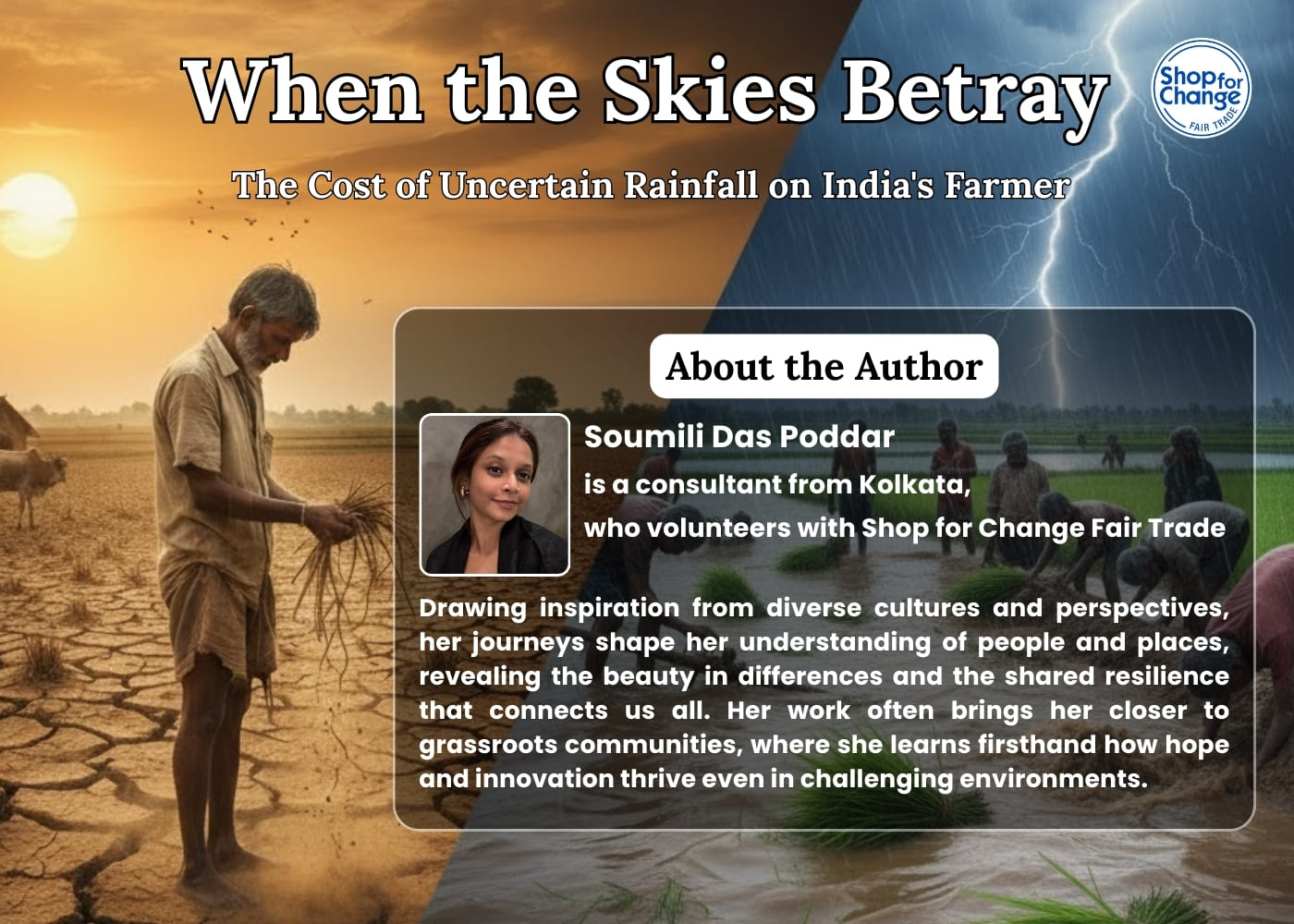
When the Skies Betray: The Cost of Uncertain Rainfall on India's Farmers
The rhythm of life in India's heartland, where the soil has long given sustenance and pride, has always been dictated by the rain. That rhythm has faltered in recent years. The monsoon, which had for generations remained a trustworthy companion to the farmer, is turning moody: it often arrives early, sometimes late, and sometimes with a vengeance, or never at all. But this is more than a meteorological anomaly; it's a crisis that reshapes the lives of millions.
A Season of Waiting and Worry
In Beed district, Maharashtra, avocado farmer Parmeshwar Thorat stands on cracked soil, eyes scanning the sky. “We were prepared to begin sowing in early June, but the rains just didn’t arrive,” he says. “Every day of delay puts more stress on the plants and on us”.
His story is echoed across India. In 2025, the southwest monsoon arrived early in Kerala but stalled over key agricultural states like Maharashtra and Bihar, leaving farmers in limbo. While some regions were inundated with floods, others faced drought-like conditions. This uneven distribution of rainfall disrupted sowing calendars, delayed crop cycles, and increased the risk of crop failure. (The Better India, n.d.)
The Numbers Behind the Crisis
According to a report by the Forum of Enterprises for Equitable Development (FEED), about 80% of marginal farmers in India have reported crop losses during extreme climatic events within the past five years. At 41%, droughts contributed to the greatest part of the damage, followed by irregularities in rainfall at 32% and early or late arrival of monsoons at 24%.
In 2025, Crisil's Rainfall Distortion Index reached its highest positive reading in 14 years, which implies both widespread and excessive rainfall across key kharif states. Punjab showed a staggering 478% surplus, while Haryana and Rajasthan recorded 390% and 371%, respectively. While this may seem beneficial, excess rainfall often leads to waterlogging, pest infestations, and post-harvest spoilage.
The Human Toll
To farmers, these are statistics that translate into sleepless nights, mounting debts, and shattered hopes. Crop failures mean not just economic loss but emotional devastation. The uncertainty has resulted in increased farmer suicides, particularly among smallholders who cannot afford the financial cushion to absorb repeated shocks.
Paddy farmers in Bihar, where rainfall was 50% below normal in early July, could not transplant seedlings as the nurseries dried up. This was the third consecutive year of monsoon shortfall for the state.
Climate Change: The Invisible Hand
This peculiarity in the rainfall is not an accident but a symptom of a bigger problem. Climate change has disrupted the pattern of the monsoon. As the air grows warmer, it is able to hold more moisture, which falls as intense downpours, followed by prolonged dry periods. Rising temperatures over the Indian Ocean have weakened monsoon circulation, particularly over central India, where average rainfall has declined by around 10 percent since the mid-20th century.
Extreme weather events are on the rise. In 2024, India witnessed extreme weather for 255 out of 274 days, affecting more than 3.2 million hectares of crop area. These events; floods, droughts, heatwaves; are no longer abnormalities but have become the new normal.
Government Response: Too Little, Too Late?
While the government of India has acknowledged the crisis, the responses have largely been reactive. Relief packages and crop insurance schemes do exist; however, they are full of delays and inefficiencies. In Gujarat, for instance, the state government initiated a rapid survey to assess damage from unseasonal rains affecting over 10 lakh hectares. Financial assistance was promised, but farmers remain skeptical about timely disbursement.
According to experts, what India needs is a paradigm shift-from post-disaster relief to proactive climate-resilient planning. While the National Innovations in Climate Resilient Agriculture (NICRA) has identified more than 310 districts as high-risk zones, implementation of adaptive strategies has been very slow.
The Way Forward
Yet, farmers are not giving up. Across India, many of them have been experimenting with shorter-duration crops, building micro-wells, and adopting rainwater harvesting techniques. Localized weather forecasting and community-based advisories further help farmers make informed decisions.
Policy experts suggest shifting to less water-intensive crops, improving irrigation infrastructure, and integrating climate data into agricultural planning. The multi-sectoral approach for flood and drought management using the World Bank's EPIC Response framework is being piloted in Assam.
A Personal Reflection
As I dove deep into the reports, data, and stories from across India, one thing became quite clear: this is not just a story about agriculture; it's a story of resilience-of people who get up every morning, look up at the sky, and hope. It's about a country whose backbone is bending but not breaking.
The uncertainty of rainfall has now become a defining feature for millions of farmers. A monsoon that fails ultimately gives way to the failure of their livelihood. And yet, they try again. More than anything else, this is both admirable and deeply moving. It reflects a kind of quiet strength that often goes unnoticed in policy debates and economic forecasts.
Reading through the endless accounts, I was struck by the emotional weight borne by these communities. Behind every statistic, be it crop loss percentages or rainfall deviation, is a family navigating uncertainty. A failed harvest does not mean financial strain but also postponed dreams, deferred education, and meals skipped to stretch dwindling resources. The human cost is immense yet rarely makes headlines.
Remarkably, the ways in which farmers have learned to adapt continue: a switch to shorter-duration crops, rainwater harvesting, and weather advisories at the community level. These are not survival strategies but acts of innovation born from necessity. They reflect a deep understanding of the land and an unwavering commitment to protect it, even when nature seems to turn its back.
This resilience is not passive; it's active, deliberate, and often courageous. It is seen in the decision to replant after a failed season, to invest in new techniques despite limited resources, and to trust that the next monsoon might be kinder. It's a form of hope that is fragile yet fierce. Climate change has made this hope harder to hold onto. The extreme weather events are more frequent, and the margin for error is also shrinking. Yet farmers show up repeatedly for their land, for their family, and for their community. And their stories are lessons in adaptability and strength, not just tales of endurance.
I am but an outsider looking in yet feel humbled by the crisis that is unfolding. The spirit of the farmers of India, though quiet in nature, is steady, and greatly inspiring. It reminds us that resilience is not just about survival of adversity; rather, it is an act of metamorphosis. The rain may be uncertain, but the determination of those who depend on them is not. And if we, as a society, can learn from their example-if we can match their resolve with action, empathy, and support-we might just find a way to weather the storms ahead.